What Happens in a Hearing Test? A Walkthrough of Your Hearing Assessment
Most people, especially women, put off a hearing test for years. 7-10 years, according to most research, which is a remarkably long time to keep asking your partner to repeat themselves! Part of the delay comes down the ease of just turning up the TV, or how busy our lives are. But a big chunk of it is simply not knowing what you're walking into.
So, let's clear that up. A hearing assessment is one of the easiest, most comfortable health appointments you'll ever attend. It’s also one of the best things to do to lower dementia risks!
There’s nothing sharp, nothing invasive, no fasting beforehand, no dodgy gown. You sit in a quiet room, listen to some sounds, answer a few questions, and walk out with a clear picture of how your ears are performing and if you have sufficient hearing loss to need a hearing aid. Here's exactly how the whole thing unfolds.
Before you arrive
You don't need to do much, but a few small things make the appointment far more useful.
Bring a list of your medications. Some drugs affect hearing, and your audiologist needs the full picture. Jot down any history of ear infections, surgery, loud workplaces or head injuries. If you served in the military, worked in construction, played in a band or spent decades on a farm with tractors and shotguns, mention it. That background shapes what we look for.
Bring someone with you if you can. A partner, adult child or mate who talks with you regularly often notices patterns you've missed. They'll say things like "He never hears me from the kitchen" or "She turns the telly up to 40". That kind of detail is gold!
One practical tip: Avoid loud noise for at least 16 hours before your appointment. A concert, a shooting range or a day with the angle grinder can cause a temporary shift in your hearing that skews the results. If your ears have been ringing recently, be sure to mention it.
.jpeg)
Step one: The conversation
Your appointment starts with a chat, not a machine. Expect around 10 to 15 minutes of questions, and expect them to be more interesting than you'd think!
Your audiologist will want to know when you first noticed a change. Whether one ear seems worse than the other. Whether you struggle more in cafés and pubs than at home. Whether you get ringing, buzzing, dizziness or a blocked feeling. Whether hearing loss runs in the family.
They'll also ask about your daily life, because that's what the results eventually need to support. A retired schoolteacher who plays lawn bowls twice a week has different needs to a construction supervisor who spends half his day on the phone in a noisy site office. Answer honestly. There's no prize for downplaying things.
Step two: Looking inside your ears
Next comes an otoscopy. Your audiologist uses a small torch with a magnifying lens, called an otoscope, to look down each ear canal. It takes about a minute per side and feels like nothing at all.
Here, they're checking the health of your ear canal and eardrum. Sometimes the answer to "Why can't I hear properly?" turns out to be a solid plug of earwax, which is both common and easily sorted using microsuction. Other times they'll spot signs of infection, fluid behind the eardrum, a perforation or unusual growths. All of this matters, because it changes how the rest of the results get interpreted.
If wax is blocking the view, your audiologist will usually remove it there and then or arrange for it to be cleared before testing continues.
Step three: Testing how your eardrum moves
This is the one people remember, mostly because it feels a bit odd! A soft probe sits in your ear canal and creates a gentle change in air pressure. You'll feel a slight fullness, similar to the sensation on a plane, and hear a low humming tone. It lasts a few seconds per ear.
The test measures how well your eardrum and middle ear bones move. A healthy middle ear flexes nicely. If there's fluid, negative pressure, a perforation or stiffness in the tiny bones, the graph looks noticeably different. This is how audiologists separate conductive problems, which happen in the outer or middle ear, from sensorineural problems, which involve the inner ear or hearing nerve. That distinction matters enormously, because conductive issues are often medically treatable.
Your audiologist may also run acoustic reflex testing, which uses louder sounds to trigger a tiny protective muscle contraction in the middle ear. It gives extra information about how the whole system is functioning.
Step four: The beeps
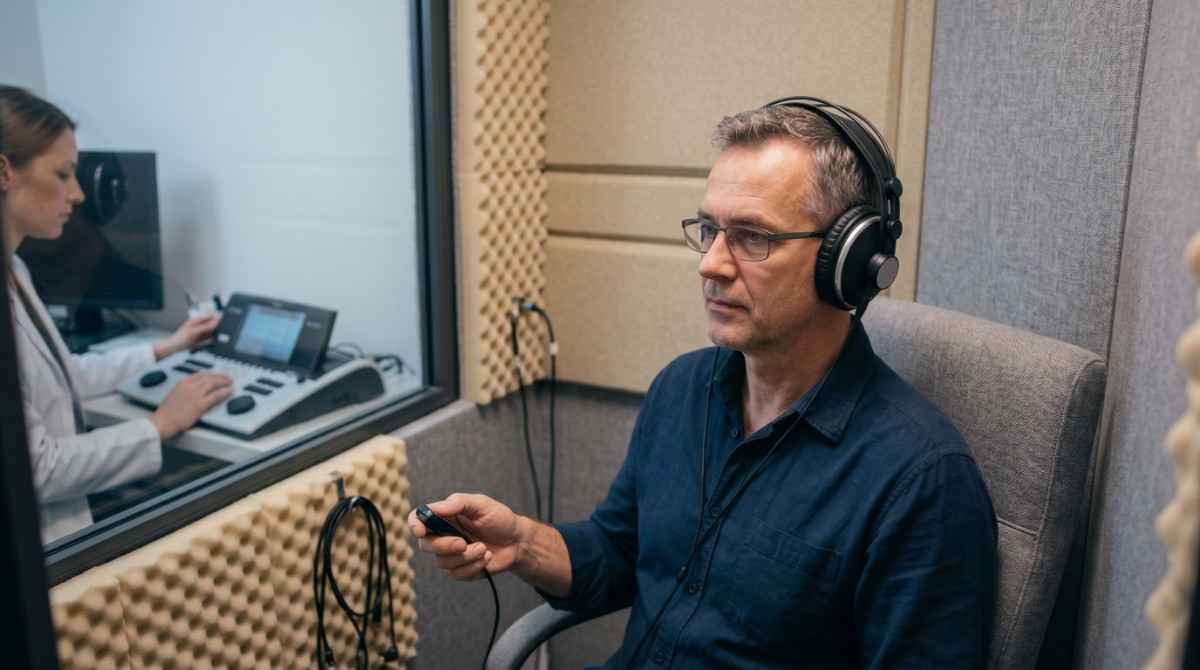
Now for the part everyone pictures! You'll sit in a sound-treated booth or a very quiet room, wear headphones or small insert earphones, and hold a button.
Your audiologist plays tones at different pitches, from low rumbles around 250 Hz up to high frequencies at 8000 Hz. Each tone starts at a comfortable level and gets quieter until you can barely detect it. You press the button every single time you think you hear something, even if you're not certain. Especially if you're not certain, in fact! The faintest tones you can just barely catch are exactly what we're measuring.
People often feel like they're failing this test. You're not. Guessing at the edge of audibility is precisely the point, so don’t worry too much about it.
The second half uses a bone conduction device, a small vibrating headband that sits behind your ear. It sends sound straight to your inner ear, bypassing the ear canal and middle ear entirely. Comparing the two sets of results tells your audiologist exactly where in the system the problem sits.
All of this plots onto a graph called an audiogram. Pitch runs along the bottom, loudness runs down the side, and your results form two lines, one for each ear.
Step five: Speech testing
Beeps tell us about sensitivity, but they don't tell us how well you understand actual words, which is what people genuinely care about.
So, in this step, you'll repeat words back. Sometimes single words, sometimes sentences, delivered at various volumes. Then comes the test that reflects real life most closely: speech in a noisy space. You'll hear sentences with background babble layered underneath, mimicking a busy café or a family barbecue.
This is where a lot of people have their lightbulb moment. Plenty of Australians hear fine in a quiet lounge room and struggle badly the second there's competing noise. The speech in noise score explains why, and it directly shapes which hearing aid technology suits you. Bernafon devices, for instance, have built a strong reputation for speech clarity in noisy settings, while Oticon's approach focuses on giving your brain a fuller, more natural sound picture. Your scores help decide which philosophy fits.
When do you get your results?
You won't have to follow-up or wait for a letter. Your audiologist explains everything before you leave, usually with the audiogram on screen in front of you.
They'll show you which frequencies have dropped and by how much, whether both ears match, and what that means practically. High frequency loss, the most common pattern, explains why voices sound mumbled rather than quiet, and why consonants like s, f, th and sh disappear first. Suddenly the "Everyone mumbles these days" theory makes sense.
You can ask any questions you like at this stage too!
Then you'll discuss options. That might mean no action beyond a review in 12 months. It might mean a referral to an ENT specialist if something needs medical attention. Or it might mean discussing hearing aids, in which case you'll cover styles, features, budget and funding pathways including private purchase, WorkCover and the Australian Government Hearing Services Program.
.jpeg)
How long does it all take?
Budget an hour for a comprehensive adult assessment. Some appointments run to 90 minutes if the picture is complicated or you're exploring devices.
That's a single hour to understand something that affects every conversation you have. When you frame it that way, the 7-10 year wait just isn’t worth it.
Now you know, it’s time to finally make that appointment
Our audiologist-led clinics in Footscray and Richmond run full diagnostic hearing assessments with qualified clinicians who handle your care from the first test through to fitting and follow-up. We’re here to help you whether you’re 30 or 80, and we can do hearing tests for children over the age of 10 too. As an independent practice, we work across Oticon, Bernafon, Starkey and other leading brands, so our recommendations for the best hearing aids or devices aren’t linked to sales commission, and they follow your results rather than a supplier's catalogue.
Same-day and next-day appointments are usually available. Book a consultation online or give us a call, and we'll talk you through it.
FAQs
Does a hearing test hurt?
Not at all! Nothing sharp goes anywhere near you, and the most unusual sensation comes from tympanometry, where a gentle pressure change feels like the pop you get on a plane. It lasts seconds. Most people find the whole appointment more relaxing than a dental check-up. Our Footscray and Richmond clinics keep things calm and unhurried throughout, and we often have same-day and next-day appointments available in the week.
How long does a hearing assessment take?
Allow a full hour for a comprehensive adult assessment. Appointments may stretch to around 90 minutes if your results need extra investigation or you want to explore hearing aid options properly. We never rush you out the door. Same-day and next-day appointments are often available at both locations, so booking is convenient and rarely means a long wait.
Do I need a GP referral?
No referral is needed to book a hearing assessment at earLAB. That being said, a referral from your GP or an ENT specialist may help you meet the eligibility criteria for a Medicare rebate, so it's worth asking. Different rules apply for WorkCover claims and the Australian Government Hearing Services Program. Ring our Footscray or Richmond clinic and we'll explain exactly what suits your situation.
How much does a comprehensive hearing exam cost?
The cost of a comprehensive hearing test at EarLAB is $170. A GP or ENT referral may help you meet the eligibility criteria for a Medicare rebate on your assessment. If you go on to purchase a hearing aid from us, the cost of your comprehensive assessment gets credited towards the final price of your device. Call our Footscray or Richmond clinic for clear pricing before you attend.

Lisa Wong
BHSc(Psych). DipNatHT. DipHDPE. CertAuralMicrosuction. AACAud
More Articles